
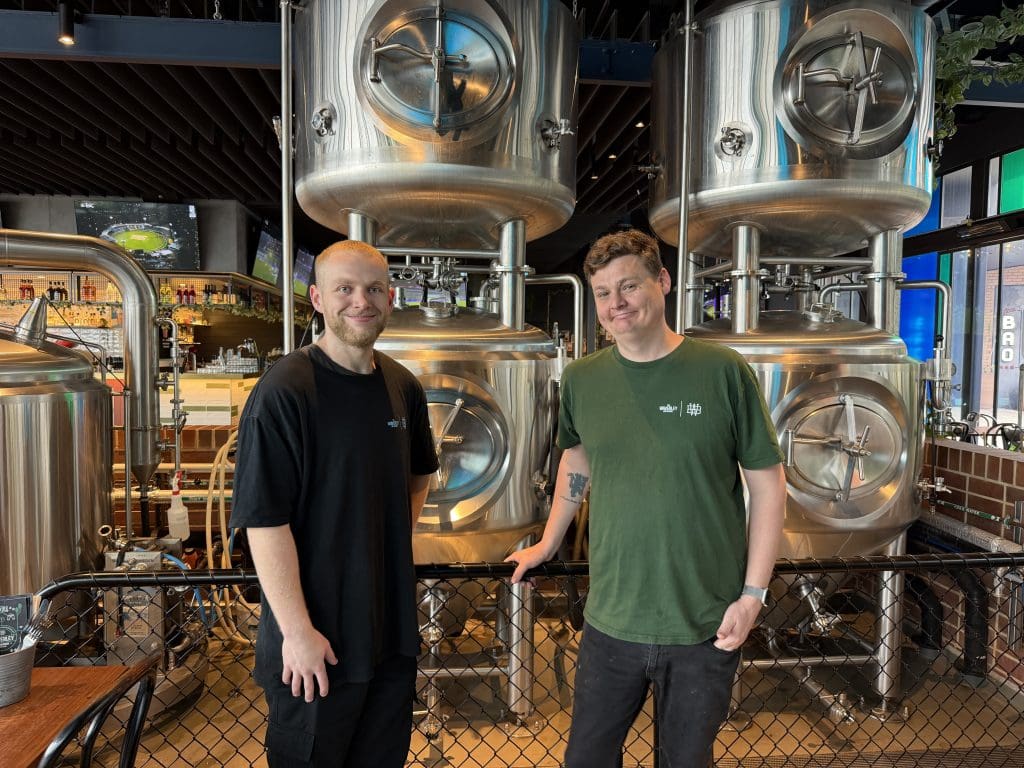
When Tyler first connected with HDNWA in 2022, he was looking for an opportunity to build his confidence, gain experience in hospitality and see where the industry might take him.
He started at The Waverley Brewhouse as a Food and Beverage Runner and, over time, gradually took on more responsibility as his skills and confidence developed. Tyler progressed into Pass and Expediting, then Bar, before moving into Higher Duties and supervised Duty Manager shifts.
At the beginning, one of the biggest challenges for Tyler was customer interaction and becoming comfortable talking to people he did not know.
“I didn’t really expect to get this confident. I was more looking at getting the confidence to work on the floor and bar and then seeing where I could go with it.”
“Customer interaction was the major thing. It was getting used to talking to strangers, but once you get used to doing it, it becomes pretty easy.”
Over time, that became one of the areas where Tyler grew the most. He is now confident interacting with customers, managing difficult conversations and helping resolve issues when they arise.
His progression has been gradual and practical. When he first started learning the bar, Tyler was rostered on quieter shifts so he could become comfortable with the tills, drinks and cocktails before moving into busier nights and weekends. The same approach was taken when he began stepping into management responsibilities.
“The first shift I did by myself, I felt very prepared because of the training. Doing a Monday day shift was a great introduction because it was definitely quieter.”
Tyler has since completed the required responsible service management accreditation and now takes responsibility for independently running shifts, managing tills, supporting staff, dealing with customers and overseeing the venue during service.
For Tyler, reaching this point means a lot. “It means a lot. It shows that I’ve progressed so far that I can handle that much responsibility and that I’ve got Chris’s trust.”
A pathway built over time
A big part of Tyler’s progression has been the way his Venue Manager, Chris Howell, has approached his development.
Rather than deciding what success should look like for Tyler, Chris has focused on understanding what he enjoys, where his strengths are, what he still wants to learn and where he wants to go next.
“One of the things we’ve tried really hard to do is let him own his own journey. We haven’t decided for him what success should look like. We’ve kept talking about what he enjoys, what he is good at, where he wants to go next and what gaps we can help him close.”
That development has not been rushed. New responsibilities were introduced gradually, giving Tyler the opportunity to build the foundations first and then take on more as his confidence and experience grew.
“We let him build the foundations first, understand the venue and the team, and then gradually take on more responsibility. That is how we develop managers generally, and Tyler has followed that same pathway.”
For Chris, good inclusion is closely connected to good management.
“Good inclusion isn’t about lowering expectations. It’s about understanding the individual, being clear about what the role requires, recognising where they are already strong and giving them the support and opportunities to build the rest. That is good management for any employee.”
Tyler’s progression has also followed a pathway Chris believes is particularly valuable in hospitality.
“In hospitality, some of the best managers are the people who understand the business from the ground up. They know what it is like to run food, work the bar, deal with customers, support the team and manage a busy service. That practical experience is what gives someone a strong foundation as a manager.”
What stands out in Tyler’s journey is that there has been no complicated formula behind his development. Chris has taken the time to understand where Tyler was confident, where he needed more experience and what he wanted to work towards next. New responsibilities were introduced gradually, with clear expectations and the same focus on skills and development that would apply to any other emerging leader.
Lorem ipsum dolor sit amet, consectetur adipiscing elit. Ut elit tellus, luctus nec ullamcorper mattis, pulvinar dapibus leo.
Making inclusive employment practical for businesses
Tyler’s story is also a strong example of what inclusive employment can look like in a medium-sized hospitality business.
Chris has always been supportive of inclusive employment and believes businesses should reflect and contribute to the communities in which they operate.
“For me, this is bigger than recruitment. Businesses are part of their communities. We employ people from those communities, our customers come from those communities, and I think we have a responsibility to make sure our workplaces reflect that and create opportunities for people who might otherwise be overlooked.”
For a business like The Waverley Brewhouse, however, the challenge is often not willingness. It is capacity.
“In a business our size, a lot ultimately sits with me as the Venue Manager. I’m responsible for staffing, recruitment, training, compliance, customers, operations and everything that comes with running the venue. I want us to be an inclusive employer, but realistically I don’t have the time or expertise to understand every provider, every funding stream, every referral process or every internal system.”
That is where Chris says HDNWA makes the process much easier.
“Having one network makes a huge difference. I don’t have to build relationships with five different providers and work out how each of them operates. I can talk to HDNWA about the role and what we need, and they can look across their network and connect us with suitable candidates from different providers.”
It means Chris can focus on what he sees as his role as a manager.
“I can focus on what I should be focusing on as a manager: is this person right for the role, how do we train them well, and how do we help them succeed in the business?”
Chris also sees HDNWA’s understanding of hospitality as a major part of why the relationship works.
“Having people who inherently understand our industry and what we need from our team makes all the difference. Hospitality is fast paced, customer focused and operationally demanding. HDNWA understands that without me having to explain it. They understand the roles, the pressures, the team environment and what makes someone a good fit.”
For Chris, this is important because inclusive employment should not require a business owner or manager to become an expert in the disability employment system.
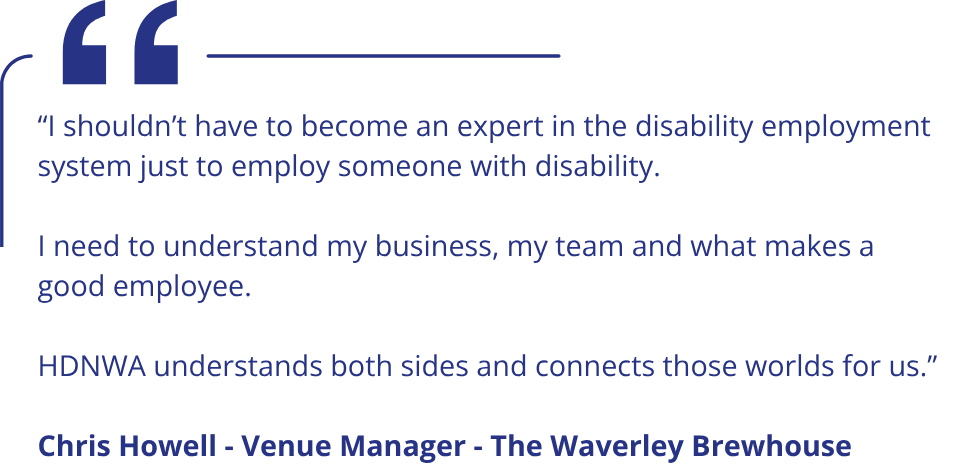
The support also continues after somebody gets the job.
“They don’t disappear once somebody gets the job. If something comes up, I know I have one point of contact who already understands the venue, the employee and the wider provider network. I’m not starting again or trying to work out who is responsible for what.”
Building confidence to do more
Tyler’s success has also strengthened The Waverley Brewhouse’s confidence to continue recruiting inclusively.
“Seeing how well this has worked has absolutely made me more confident to employ other people through the network. Once you see someone come in, grow with the business and become a really valuable team member, it changes how you look at inclusive recruitment.”
The venue has since returned to HDNWA when further employment opportunities have become available.
“The success we’ve had has made me comfortable going back to HDNWA when we have other vacancies. I know they understand the venue, they understand what works here and they can put forward candidates who are genuinely suited to the role. That takes a huge amount of pressure off me.”
For Chris, the experience has also influenced his own approach to management.
“It has made me a better manager as well. You become more conscious of how you train people, how you communicate and how you create opportunities for someone to develop. Those are good management practices for everyone.”
His advice to other small and medium-sized hospitality and tourism businesses is straightforward.
“If I had one piece of advice for other SMEs in the industry, it would be to connect with HDNWA. You don’t need to know everything yourself. You need to be willing to give people an opportunity and have the right network around you to help make it work.”
For Chris, the strongest outcome is that inclusive employment has simply become part of normal workforce thinking.
“Once you have had a successful experience, you stop thinking of inclusive employment as something separate. You start thinking about it as another way to find good people, develop them and build a stronger team.”
More than getting a job
For Tyler, the impact of the past four years has extended beyond the workplace.
“One hundred per cent. I’m able to talk to people outside of work a lot easier because I’ve done it so often at work.”
When asked what he is most proud of, he comes back to the confidence he has built along the way.
“I’m most proud of how much confidence I’ve gained. Being able to do this job and go as far as I’ve gone, I’ve been able to do so much more than I thought I would.”
Tyler’s journey is a strong example of what can happen when someone is given a genuine opportunity to work, learn and develop over time. He started in an entry-level role, built his skills through real workplace experience and has now progressed into management.
For HDNWA, that is exactly the kind of outcome we want to see. Not simply helping someone secure a job, but working alongside employers, candidates and providers to create the conditions for people to stay, develop and build meaningful careers.